The Master of Arts in Digital Technologies for Language Teaching of the University of Nottingham is running a survey about teachers' opinions and attitudes towards postgraduate study.
Your participation in the survey will be greatly appreciated and will help us deliver better services to our future students. Also, respondents in the survey will have a chance to win a SanakoStudy Solo license (http://www.sanako.com/products/study-1200/study-solo/). The drawing will be conducted on 5 September 2016 and the three lucky winners will be announced on the Facebook page of the MA in Digital Technologies for Language Teaching (https://www.facebook.com/UoN.MA.DTLT) and will be contacted via email.
The survey consists of 23 questions and will take approximately 5-7 minutes to answer.
To answer the survey click the link below: http://goo.gl/forms/ryM1SsD2Uv4VYVaB2
Saturday, 2 July 2016
Wednesday, 22 June 2016
Join us on Twitter for a chat about the Master of Arts in Digital Technologies for Language Teaching programme #dt4lt
We invite you to our Questions & Answers (Q&A) sessions on Twitter where you will have the opportunity to discuss your questions about studying online for the Master of Arts in Digital Technologies for Language Teaching of the University of Nottingham and get answers from a team of tutors and students.
Join us on Twitter using the #dt4lt hashtag on Monday 18th July from 11-12 am (check your time zone) and on Wednesday 20th July 2016 from 3-4 pm (UK time) (check your time zone).
Looking forward to e-see you!
Thursday, 16 June 2016
And the winners of the Language Learning Lesson Plan Competition are…
We would like to thank all teachers who took part in our 2nd Language Learning Lesson Plan Competition. We had some truly great lesson plans submitted and it was quite difficult to pick the winners. So, congratulations not only to the winners but to all entrants!
The three winners are:
1st winner: Dimitra Theodosiadou
2nd winner: Emanuela Leto
3rd winner: Zoe Theodosaki
Their lesson plans can be viewed and downloaded at the following link:
https://www.pinterest.com/dt4lt/language-learning-lesson-plan-competition/
or at:
http://thelanguagepoint.com/english_collections/show/Worldwide_Lesson_Plan_Competition
Each winner will receive a certificate of achievement, an Amazon voucher and a number of Sanako Study Solo Licences.
Stay tuned to our Facebook page (https://www.facebook.com/UoN.MA.DTLT) and keep following us on Twitter (@dt4lt) for more news about the Lesson Plan Competition and new events!
The three winners are:
1st winner: Dimitra Theodosiadou
2nd winner: Emanuela Leto
3rd winner: Zoe Theodosaki
Their lesson plans can be viewed and downloaded at the following link:
https://www.pinterest.com/dt4lt/language-learning-lesson-plan-competition/
or at:
http://thelanguagepoint.com/english_collections/show/Worldwide_Lesson_Plan_Competition
Each winner will receive a certificate of achievement, an Amazon voucher and a number of Sanako Study Solo Licences.
Stay tuned to our Facebook page (https://www.facebook.com/UoN.MA.DTLT) and keep following us on Twitter (@dt4lt) for more news about the Lesson Plan Competition and new events!
Monday, 13 June 2016
Lesson Plans submitted to the Competition are now available online!
Find a collection of lesson plans submitted to the Language Lesson Plan Competition organised by the social media promotion team of the MA in Digital Technologies for
Language Teaching on Pinterest: https://www.pinterest.com/dt4lt/language-learning-lesson-plan-competition/
Monday, 6 June 2016
Guidelines for successful telecollaboration - Robert Martinez
What are the guidelines for developing a successful telecollaborative project? And, what are the potential hurdles? Such questions are answered in the wiki of the "Telecollaboration in Language Learning" module: http://telecollaboration20.wikispaces.com/
The wiki currently contains the work of one of the students in the module, Robert Martinez, but it will be populated with more content in the future from future student assignments.
Saturday, 4 June 2016
A series of videos on Technology-Enhanced Creative Writing - John Chalk
Are you interested in creative writing for language teaching? Watch a series of interactive videos on creative writing created by one of our students, John Chalk
Wednesday, 18 May 2016
Five things to know about the MA in Digital Technologies for Language Teaching
Our recently created poster provides essential info about the Master of Arts in Digital Technologies for Language Teaching programme. The poster helps prospective students easily decide whether our programme is appropriate for them and take the next step to gather more information about it.
Monday, 18 April 2016
Studentships for the MA in DTLT
The School of Cultures, Languages and Area Studies is offering a number of studentships and fee waivers for students of the Master of Arts in Digital Technologies for Language Teaching. Masters studentships include home fees-only awards and home-fees plus stipend awards.
To be eligible to apply for School funding, you must be holding an offer of a place to study at the MA in Digital Technologies for Language Teaching of the University of Nottingham.
The deadline for submitting the completed application form is on 11th May 2016.
More info and application form: http://www.nottingham.ac.uk/
To be eligible to apply for School funding, you must be holding an offer of a place to study at the MA in Digital Technologies for Language Teaching of the University of Nottingham.
The deadline for submitting the completed application form is on 11th May 2016.
More info and application form: http://www.nottingham.ac.uk/
Thursday, 7 April 2016
Gamification and Ludology: Presentation recording
Ivan Lombardi talked about two uses of gamification at the Teaching & Learning Seminar. Firstly at the University of Fukui (Japan) where Fukudai Hero is a video game-like English class for students of Engineering (with low motivation to take compulsory English classes). It aims to strengthen the students’ engagement with the class content (usually a range of topics for basic communication in English) by using core game elements like quests, a point system, and free choice. At Nottingham, the online MA Programme in Digital Technologies for Language Teaching includes a gamified module on Game-based learning.
Recording of the presentation: http://comms.nottingham.ac.uk/learningtechnology/2016/04/19/seminar-gamification-and-ludology-6-april-2016-recordings/
Monday, 22 February 2016
Don't miss the chance to join the Second Language Lesson Plan Competition!
The social media promotion team of the Master of Arts in Digital Technologies for Language Teaching is hosting the second lesson plan competition for all language teachers and language professionals worldwide. Teachers who enter the competition will have the chance to share their lesson plans in language learning with other teachers all over the world and get recognition for their work. Additionally, in order to encourage participation and showcase the abilities and creativity in lesson design of teachers, there will be three awards for the best three contributions:
Submissions are accepted from 22nd February and the submission deadline is on22nd April 2016 at 23:00 (UK time) deadline extended: 30th May 2016. Winners will be announced on the Master of Arts in Digital Technologies for Language Teaching Facebook page and will be notified by email.
Terms & Conditions
Competition entries will be assessed on the basis of the following criteria:
If you have any questions or require additional information about the competition, please contact us at digitaltechnologies4lt@gmail.com or tweet as at @dt4lt or leave your message at the message box of our Facebook page, https://www.facebook.com/UoN.MA.DTLT.
Follow MA in Digital Technologies for Language Teaching on Facebook (https://www.facebook.com/UoN.MA.DTLT) and Twitter (@dt4lt) for updates and other info about the competition.
- First winner: 5 Sanako Study Solo Licences + 50£ Amazon voucher;
- Second winner: 4 Sanako Study Solo Licenses + 30£ Amazon voucher;
- Third winner: 3 Sanako Study Solo Licenses + 20£ Amazon voucher.
Submissions are accepted from 22nd February and the submission deadline is on
Terms & Conditions
- The lesson plan submitted must follow the Lesson Plan Template provided as download. Participants are allowed to add or modify fields in the template to suit better the needs of their lesson plan.
- The content in the lesson plans must be the work of the contestant(s). Entries with plagiarized material will be excluded from the contest.
- Lesson plans should normally fall between 700 and 1500 words in total.
- Any images used in the lesson plans must be owned by the contestant or royalty free or correctly cited.
- The lesson plans should integrate digital technologies in language teaching.
- Each contestant can submit more than one lesson plans, but may win only one of the awards.
- Although contestants can collaborate to create a lesson plan and enter the contest, there will be only one prize for each entry.
- The lesson plans must be sent to the digitaltechnologies4lt@gmail.com by the deadline. Late submission will not be considered.
Competition entries will be assessed on the basis of the following criteria:
- Clearly stated lesson aims and learning outcomes appropriate to the designated level(s)
- Logically sequenced activities which support the achievement of the lesson aims
- Technology integration in the learning activities
If you have any questions or require additional information about the competition, please contact us at digitaltechnologies4lt@gmail.com or tweet as at @dt4lt or leave your message at the message box of our Facebook page, https://www.facebook.com/UoN.MA.DTLT.
Follow MA in Digital Technologies for Language Teaching on Facebook (https://www.facebook.com/UoN.MA.DTLT) and Twitter (@dt4lt) for updates and other info about the competition.
Sunday, 21 February 2016
Lesson Plan Template for the competition
The Lesson Plan template for the Language Lesson Plan Competition is available for viewing and download on Scribd and Google Drive:
Monday, 25 January 2016
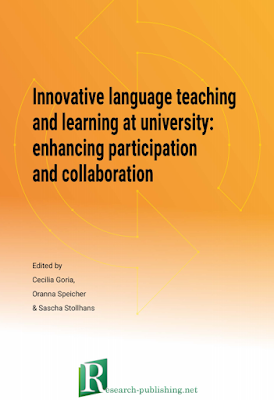
Conference Volume: "Innovative language teaching & learning at university"
The School of Cultures, Languages and Area Studies at the University of Nottingham hosted the fifth annual conference in the "Innovative Language Teaching at University" #InnoConf15 series. Under the heading "Enhancing participation and collaboration" the conference, organised by Cecilia Goria, Oranna Speicher and Sascha Stollhans, took place on 19 June 2015, and was attended by over 120 linguists, language teachers and language acquisition researchers from all over the world.
The edited volume of the conference contributions (freely available at: http://dx.doi.org/10.14705/rpnet.2016.9781908416322) contains 15 selected peer-reviewed case studies, research studies and reflective pieces which are concerned with a number of languages and most chapters deal with the innovative use of technology in language teaching and/or online collaborations. The volume also contains an invited contribution by Dr. Jan Hardman and a foreword by Professor Zoltán Dörnyei.
Friday, 18 December 2015
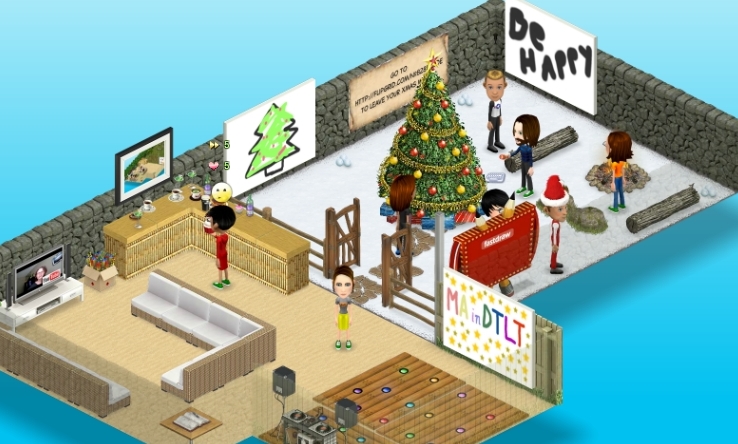
Wonderful party on SmallWorlds today (Screenshots)
Our Xmas virtual party was a great success today! There was a variety of cakes, a Christmas turkey, plenty of drinks, fireworks, and snowballs! We danced a lot, we had a snowball fight, we wrote wishes on the walls, and we watched videos from students & tutors on the FlipGrid. By the way, the FlipGrid is still open, so you still have the chance to take part and leave your Christmas message (or song!!!). Students from all three cohorts popped in and enjoyed the event making it very special!
Below you can see a collection of pictures from the event (feel free to download and share on social media):
Again, thank you all for your participation :-)
Merry Christmas and a Happy New Year!
The social media team of the Master of Arts in Digital Technologies for Language Teaching
Below you can see a collection of pictures from the event (feel free to download and share on social media):
Again, thank you all for your participation :-)
Merry Christmas and a Happy New Year!
The social media team of the Master of Arts in Digital Technologies for Language Teaching
Thursday, 17 December 2015
Join our Xmas party on SmallWorlds on Friday!
We are having a Christmas party on Friday 18th December 2015 at 10-11 am (UK time), at the MA in DTLT space on SmallWorlds and everyone is invited! There will be food, games, dance, snow and lots of laughter so try not to miss it!
Directions to the MA in DTLT space: On SmallWorlds select Places (bottom of the screen), then Search (menu on the left) and then type in "MA in DTLT". On the right you will click on Go there (orange button) which will teleport you to the space.
Friday, 4 December 2015
Screenshots from today's tutorial on SmallWorlds
This week's tutorial for the Introduction to Digital Technologies for Language Teaching module has been held on SmallWorlds. The tutorial started with a dancing activity under the sounds of popular international songs. Next, students and tutors discussed about the affordances of Virtual Worlds for language teaching and learning and finally they played word games. During the tutorial several guests popped in, while some of them contributed to the discussion too. All in all it was a great tutorial; thank you all for your participation!
The following screenshots/pictures are from today's tutorial. Feel free to download and use it on Social Media!
Monday, 30 November 2015
Tutorial on SmallWorlds this week!
This week's topic in the "Introduction to Digital Technologies for Language Teaching" is about Virtual Worlds and the tutorial will be held on SmallWorlds!
Sunday, 15 November 2015
A huge thanks to all teachers who replied to our call!
We are happy that many teachers worldwide answered to our call and submitted their telecollaborative projects for consideration. Due to this huge interest our students in the "Telecollaboration in Language Learning" module were presented with an array of choices and, thus, it was easier for them to find a telecollaborative project that was closer to their context and their interests. We thank you all for this!
Thursday, 12 November 2015
Let's get down to e-business! - case study of a telecollaborative project
One of the assignments in the “Telecollaboration in Language Learning” module of the Master of Arts in Digital Technologies for Language Teaching (MA in DTLT) asks students to study closely the what’s and how’s of real-world telecollaborative projects.
The eTwinning project "Let's get down to e-business!" co-organised by Eva Toth, an English teacher at a technical and vocational school in Hungary, was selected as a case study for its innovative and close to real life activities.
Karina Pearl Thorne, student of the MA in DTLT, who examined this project in her paper reported that: "The potential for digital technology to enhance and extend learning beyond the walls of the classroom is no more evident than in the project Let's get down to e-business!".
Students and tutors of the MA in DTLT would like to thank Eva Toth for her time and contribution to the TLL module.
The eTwinning project "Let's get down to e-business!" co-organised by Eva Toth, an English teacher at a technical and vocational school in Hungary, was selected as a case study for its innovative and close to real life activities.
Karina Pearl Thorne, student of the MA in DTLT, who examined this project in her paper reported that: "The potential for digital technology to enhance and extend learning beyond the walls of the classroom is no more evident than in the project Let's get down to e-business!".
Students and tutors of the MA in DTLT would like to thank Eva Toth for her time and contribution to the TLL module.
Friday, 6 November 2015
Let's Write a Story - case study of a telecollaborative project
One of the assignments in the “Telecollaboration in Language Learning” module of the Master of Arts in Digital Technologies for Language Teaching (MA in DTLT) asks students to study closely the what’s and how’s of real-world telecollaborative projects.
The eTwinning project "Let's Write a Story" with partners from 23 schools across Europe was selected as a case study for its creative writing activities and use of storytelling Web 2.0 tools. Robert MartÃnez, student of the MA in DTLT, who examined the "Let's Write a Story" project in his paper acknowledged that: "Investigating and interviewing an experienced telecollaborator has translated into a deeper understanding of what telecollaboration entails by adding flesh to the bones".
Students and tutors of the MA in DTLT would like to thank Loredana Popa, teacher partner in this project, for her time and contribution to the TLL module.
The eTwinning project "Let's Write a Story" with partners from 23 schools across Europe was selected as a case study for its creative writing activities and use of storytelling Web 2.0 tools. Robert MartÃnez, student of the MA in DTLT, who examined the "Let's Write a Story" project in his paper acknowledged that: "Investigating and interviewing an experienced telecollaborator has translated into a deeper understanding of what telecollaboration entails by adding flesh to the bones".
Students and tutors of the MA in DTLT would like to thank Loredana Popa, teacher partner in this project, for her time and contribution to the TLL module.
Wednesday, 21 October 2015
Students of the MA in Digital Technologies for Language Teaching write for Wikipedia
One of the assignments of the Telecollaboration in Language Learning module of the Master of Arts in Digital Technologies for Language Teaching engaged students in contributing significant new material to the Tangem Language Learning on Wikipedia. Our students extended the history of Tandem Language Learning up to the present day, enhanced the overall structure of the text, added several new sections about telecollaboration, corrected language errors, and added extra references and links.
You may see how the article was before (https://en.wikipedia.org/w/index.php?title=Tandem_language_learning&oldid=670181788) and after (https://en.wikipedia.org/w/index.php?title=Tandem_language_learning&oldid=685208568) our students’ contribution.
Subscribe to:
Posts (Atom)